

Climate, Earth, Water, Sustainability | Master
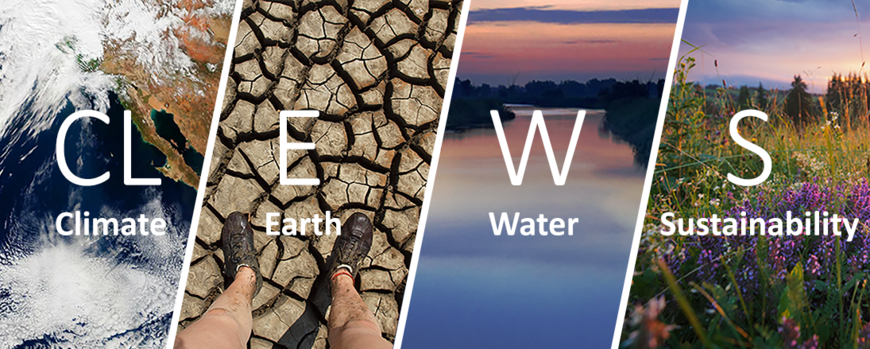
To tackle the global climate crisis, interdisciplinary and science-based approaches are essential. Graduates of our English-language master's degree program Climate, Earth, Water, Sustainability are trained to become experts in the field of climate science research capable of addressing the consequences of global warming and anthropogenic change in research, policy, and public discourse.
| Name | Climate, Earth, Water, Sustainability |
| Degree | Master of Science |
| Standard period of study | 4 Semesters |
| Credit points | 120 |
| Language of instruction | English |
| Start of program (1st semester) | Winter semester |
| Campus | Golm |
| Fees & Charges | Semester fees and charges: yes Tuition fees: no |
Program Content
Climate, Earth, Water, Sustainability (CLEWS) is a research-oriented degree program with close ties to ongoing projects at the University of Potsdam and its associated research institutions in the Potsdam science area. Most master’s theses are embedded in these research projects, allowing students to work on current scientific questions in close collaboration with active research groups.
Module content is also closely linked to the research activities of the partners and integrates current scientific topics, results, and methods into the curriculum. Modules and examinations follow a competence-oriented approach, combining the acquisition of in-depth subject knowledge with the development of methodological, social, and personal skills essential for academic and professional careers.
Program Objective and Future Career Options
In the CLEWS master's program, students will develop a comprehensive understanding of the climate system and other subsystems of the Earth system, as well as their natural and anthropogenic transformations. The program focuses on quantitative environmental research, climate and hydroscience, complemented by modules in environmental economics, science communication, policy, and risk and adaptation analysis.
Methodologically, a strong emphasis is placed on understanding the physics and dynamics underlying Earth system processes. Students receive training in data analysis, programming, and numerical modeling, enabling them to obtain, process, and analyze data from field observations, remote sensing, and Earth system models. Graduates are able to critically evaluate scientific results and communicate complex findings effectively to diverse audiences, including researchers, policymakers, and the general public.
The program provides a solid foundation for advanced research activities and prepares students to work on complex, interdisciplinary challenges related to climate change and sustainability. Graduates are well qualified for specialist and leadership positions at universities and research institutions, environmental and planning agencies, governmental agencies, NGOs, and in relevant sectors of industry, finance, and insurance. Overall, the CLEWS program offers excellent career prospects in Germany and worldwide.
Prerequisites for Master's Studies
Admission to the CLEWS master’s program requires an undergraduate academic degree from an institution of higher education in a subject relevant to the Master's degree program, such as geoecology or physics, amounting to at least 180 CP; or in the natural sciences with evidence of successfully completed modules amounting to at least:
- 12 credit points in physics,
- 12 credit points in mathematics,
- 12 credit points in earth and environmental sciences,
- and another 12 credit points in natural sciences-related modules.
Note: A minimum of 48 credit points across these four areas is required.
Since this is an English-language degree program, a very good knowledge of English, corresponding at least to level B2 of the Common European Framework of Reference (CEFR), is expected. Knowledge of the German language is not required.
Further details on the subject-specific admission requirements can be found in the respective admission regulations.
Program Structure
In the four-semester master’s program, you earn a total of 120 credit points, consisting of the following modules and your master’s thesis.
For additional information, please consult the subject-specific degree regulations or the Departmental Advisory Office.
Modules | Credit points |
|---|---|
| I. Mandatory Modules | 36 CPs |
| Data Analysis and Management in Earth System Science | 6 CPs |
| Numerical methods (Programming) & Introduction: Climate, Earth, Water, Sustainability | 6 CPs |
| Data collection in Earth System Science | 6 CPs |
| Atmospheric and Oceanic Fluid Dynamics | 6 CPs |
| Debating Club (Student seminars) & Research training (Traineeship) | 6 CPs |
Introductory module | |
| Introduction to the Earth System | 6 CPs |
| Mathematics & Physics for Earth Sciences | 6 CPs |
| II. Elective Modules Students must choose and successfully complete 9 modules from 22 areas of study. | 54 CPs |
| II.1 Climate/Atmosphere | |
| Dynamics of the Climate System | 6 CPs |
| Earth’s Climate History | 6 CPs |
| Numerical Models in Climate Science | 6 CPs |
| Atmospheric Science in the Anthropocene | 6 CPs |
| II.2 Earth | |
| Land Use – a Key Control of Earth System Processes | 6 CPs |
| Earth System Science & Anthropocene | 6 CPs |
| The Environmental Modelling Process | 6 CPs |
| II.3 Water | |
| Ocean Dynamics | 6 CPs |
| Ice Dynamics | 6 CPs |
| Basics of Terrestrial Hydrosystems | 6 CPs |
| Dryland Hydrology | 6 CPs |
| II.4 Sustainability | |
| Environmental Economics | 6 CPs |
| Economics of Climate Change | 6 CPs |
| Ecosystem Dynamics (Biodiversity) | 6 CPs |
| Recent Advances in CLEWS | 6 CPs |
| Introduction to Science & Climate Change Communication | 6 CPs |
| Natural Hazards and Risks | 6 CPs |
| Climate Change Adaptation | 6 CPs |
| Current Topics in CLEWS | 6 CPs |
| II.5 Research Project | |
| Introductory research project | 6 CPs |
| Master's thesis | 30 CPs |
| Total | 120 CPs |
Advantages at a Glance
Students will:
- develop a deeper understanding of the climate system and other Earth system components and their interactions,
- work with real-world data from field measurements and numerical models,
- acquire solid foundations in programming, data analysis, and numerical modeling,
- learn to critically assess scientific literature and research results,
- engage with interdisciplinary perspectives spanning natural sciences, economics, policy, and communication,
- benefit from close connections to internationally recognized research institutions in Potsdam.
Application and Enrollment
You want to study in the master’s degree program Climate, Earth, Water, Sustainability at the University of Potsdam? Then you should take the next step and get more information about the current application and enrollment procedures at the application website.
Contact and Advantages
Contact
The CLEWS Team
Important Links
This description is based in part on information from the Discipline-Specific Regulations for Study and Examinations for the Master’s Program in Climate, Earth, Water, Sustainability at the University of Potsdam dated February 10, 2021 (AmBek No. 10/21, p. 313), as well as the ammendments of these regualtions.